10/09/2011

Introduction of ZAP System with Alpair 6M


I’ll introduce the latest status of my new desktop system, named "ZAP" using Mark Audio Alpair 6M drivers.


Fig.1: ZAP System

Data:
Main speakers: Mark Audio Alpair 6M 3” metal-cone full-ranger; sealed enclosure with 2.5L volume
Sub-woofer: Dayton Sound DA135-8 5.5” metal-cone woofer; sealed enclosure with 2.5L volume

1. Introduction
This system is placed just above the display screen in front of me. The distance from the drivers to my ears is approx. 65cm. Since I don’t like too much stereophonic effects, the two Alpair 6M are placed considerably closer each other (the center-to-center distance = 230mm). This L/R distance is just same as KERO. I’ve found this short-span layout sounds most comfortably for listening music. Generally I’m not at all interested in so called “perspective” for enjoying music. I have never been aware of "stereophonic effects" so much. Even monaural could be acceptable. I’m not sure whether stereophonic is really necessary for most of music listeners.

2. Comparison of Alpair 5 and Alpair 6

Fig.2: Alpair 5, 6M, 6P measured at 10cm distance (Black: A5, Red: A6M, Green: A6P)

All are measured with the same 2.5L sealed box. Alpair 6M produces approx. 7.5dB higher response than Alpair 5 at 40Hz. This has improved Low-end capability significantly, thus now I can enjoy even Madonna’s heavy low beats (40 – 45Hz) with more than enough sound volume level (I call it WRC limit; Wife’s Red Card Limit) without perceptible distortions, which was not possible with the Alpair 5 system.

3. Conventional Sub Woofer Mode
I added the woofer mainly for enjoying Internet Radio, DVD, CD, whatever those sources that cannot be played back via Frieve Audio equalizer. The woofer works as a conventional sub-woofer. This was easily done because I had already studied this kind of system with Alpair 5 as described in the previous article.


Fig.3: Conventional Sub-Woofer Mode Operation

So, it is not necessary to show details of this configuration. However, I’ve found some very important aspects for LEANAUDIO concepts through this work as described below.

4. Important Aspects for LEANAUDIO Concept
4-1. Air Tightness
LEANAUDIO approach is based on "small sealed box" and "big excursion in low-end" driven by digital signal boosting or an additional amplifier. In such system, air tightness of the entire system (including box and driver) is very important. If air leaks to some extent, then you will lose low-end response somehow (because the air pushed by the cone will be sucked from the clearance to some extent), and you will hear harsh air-flow noises on big excursions such as heavy bass drums for instance. Due to this, drivers with so-called “Phase plug” (e.g. B&W drivers) or Co-Axial drivers are not suitable because of their poor air tightness.
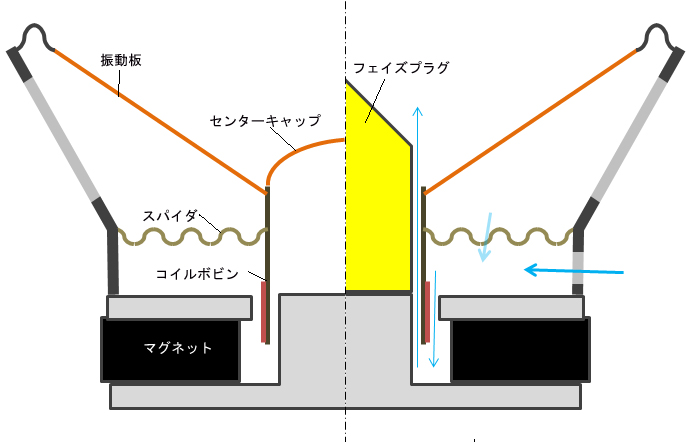
Fig.4: Driver’s Cross Section

As you can see, in some special types of drivers (e.g. with phase plug, or co-axial type) air can flow through clearances at the coil. On the other hand center-caped drivers like as Alpairs can ensure the air-tightness regardless of other structures. I had not been aware of this issue, and bought a nice looking Japanese-made woofer with a beautiful phase plug, then had to throw it away due to the air leakage problem. After that I bought the Dayton woofer that had certainly a CENTER CAP. BUT, the CENTER CAP was NOT air-tight..... It was made of some kind of fabric. WTF ! To make it air-tight, I had to coat it with woodwork glue (very popular glue among Japanese DIYers, white one).


Fig.5: Coated Center Cap


Fig.6 Response of Dayton Woofer after the Modification

Red line indicates the response measured after the modification. Fortunately, it’s not so bad or even better than original because of less peak/dip.

4-2. Xmax
The low-end capability of this woofer is almost equivalent to that of Alapir 6M x 2. This was assessed by playing 40Hz sinusoidal signal and gradually increasing the amplifiers volume with observing the sound wave-form distortions.


Fig. 7 40Hz Sinusoidal Signal Distortion, significant 3rd order condition for comparison (red: Alpair 6Mx2, blue: Dayton woofer)

These sound waves are measured with a microphone located at the listening point. As increasing the amplifiers volume, the 3rd order distortion becomes more significant than the 2nd order and the wave form becomes triangular. Absolute sound magnitude (sound wave amplitude) at this transition point (i.e. FFT 2nd peak < 3rd peak point) is almost same with both drivers (i.e. Alpair 6M x2 = Dayton Woofer x1). I expected more capability with 13cm woofer, however this result seems reasonable if consider the parameters as below:

Alpair 6M x2: Sd: 36.3 x 2 = 72.6 cm2, Xmax = 3.4mm, Sd x Xmax = 247cm3
Dayton Woofer x 1: Sd: 75.4 cm2, Xmax = 3 mm, Sd x Xmax = 226cm3

Sd: effective diaphragm area
Xmax: maximum diaphragm excursion (one way)

"Sd x Xmax" represents the "maximum swept volume" of the diaphragm. Although I’m not sure how directly this index can represent actual low-end capability, it might be useful for making very simple estimations. For example;

CHR70 x 1: Sd(50cm2) x Xmax(4.5mm) = 225cm3 (equivalent to Dayton woofer even with smaller diameter)
Alpair 10 x1: Sd(88cm2) x Xmax(7.5mm) = 660cm3 (seems have plenty of capability, try it!)

Typically, Mark Audio drivers have very big Xmax comparing to other drivers of the same class, and they also have good air-tightness due to their center-capped structure. From these two points of view, I can say, Mark Audio drivers are well suited for LEANAUDIO concept.

5. Further Improvement of Low-End Capability
Besides the conventional sub-woofer mode, the woofer can be used in a different way to assist only very low end (<50Hz) of the digital boosting method. When the woofer is working in the conventional sub-woofer mode, only the woofer works effectively in very low end range (<50Hz). Contribution of Alpair 6Ms is quite small or negligible in this case. This is wasteful. If they share the load evenly (i.e. Dayton x1 and Alpair 6M x2 contribute half and half), the low end capability could be simply doubled.


Fig.8: Very Low-end Assist – Equalizer OFF (Red: Woofer ON, Blue: Woofer OFF)


Fig.9: Very Low-End Assist – Equalizer ON (Red: Woofer ON, Blue: Woofer OFF)


Fig.10: The Strongest Bas Drum Signal in “Rite of Spring”

Fig.10 is showing the strongest low-end signal in my collection (Stravinsky/Rite of Spring (the strongest bass drum)). Gray indicates the raw signal in CD, Red indicates 60Hz High-Cut signal, Green indicates -6dB Sinusoidal 40Hz signal. To assess advantages of the new configuration, this 60Hz High-Cut signal is played back with my maximum sound volume level (i.e. WRC limit level).


Fig.11: Only Digital Equalizing to 20Hz
Significant 4th order distortion can be seen.


Fig.12: Very Low-end Assist + Digital Equalizing to 20Hz
Much improved, however still relatively high 3rd distortion can be observed.


Fig.13: Madonna's Beat (Red: Only Digital Boost, Blue: Digital + Assist)
Assist seems not necessary for Madonna's.


Fig.14: Source Signals(<60Hz)(Red:Madonna, Blue: Rite of Spring)
40Hz Sinusoidal signals are also shown (-6dB and -12dB). You can see how big the drum is!


Fig.15: Frequency Analysis of Different Tunes

Spectral profiles of some typical tunes in my collection are shown in Fig.15 ( Red: Stravinsky/Rite of Spring (40Hz the strongest bass drum), Blue: Madonna/Erotica (45Hz low beat), Green: Miles Davis/Madness (low strong part), Gray: Beethoven/Symphony No.5-I (ending)). Most of tunes in my collection including Jazz, Classics, Rock, Pops do not include strong signal in super low range (<50Hz). Green and Black in the figure represent typical profiles of those normal tunes. Alpair 5 could handle most of those tunes with the digital boosting but Madonna’s. Now, Alpair 6M can handle Madonna’s (blue in the figure), but Rite of Spring. Finally with the Very Low-End Assist method, now I can say, Alpair 6M ZAP system can playback all tunes in my collection with full boosting (down to 30Hz) with maximum sound pressure level of 80dBA with considerable margin at my listening position (dist. = 65cm).

Fig.16: Rite of Spring; Comparison of Source Signal(gray) and Actual Sound at the Listening Position(red: boost+assist, blue: no boost), without high-cut filter (i.e. raw signal)

Fig.16 is showing spectra and wave forms of "Rite of Spring" from the source signal(stereo) and the actually recorded sound(monaural) at the listening position(boost + assist, no boost). High-Cut is not applied (raw muusic soure). Volume position was WRC limit. The measured sound pressure level at the listning position was normally varying within 75-85dBA range with the peak sound pressure level of 91dBA (SLOW filter). It's a quite good result, I think, although the 3rd order distortion (128Hz) and the room effect (180Hz sharp dip) can be seen. Such very accurate sound wave reproduction of this super low range/super attack signal could never be obtained from bass-reflex boxes.


due to poor camera microphon, sound quality is bad (no low contents)

Possible further improvement could be ;
- Alpair 10 as a woofer to improve low-end capability significantly (it can be used as a monaural full ranger)
- Digital channel divider to improve phase shift problem

RECOMMENDATIONS:
Basically I would recommend limiting the low-end boost down to 50Hz (then the response decays with -12dB/Oct to approx. -6dB/40Hz -10dB/30Hz). With this setting, you will not need any special cares because Alpair 6Ms are quite tough in >50Hz range. The response seems almost sufficient for most of music.

I think 40Hz/-3dB would be the ultimate target in a practical sense. I can not feel any benefit with more than this level. Therefore, I usually apply the equalizer down to 40Hz and a very sharp digital low cut filter from 35Hz toward 20Hz to avoid unnecessary excursions.

In Super Low range (<50Hz), driver’s excursion increases drastically. The world seems completely different. I'm explporing this area as a pure technical challenge. If you challenge 30Hz flat setting, you must know spectrum profiles of critical tunes and you must exactly know the limit of your system. Otherwise you might destroy the drivers.

Further, If you are listening relatively distant from speakers (i.e. if you are not a near-field listener, e.g. if your listening position is more distant than the center of your room ), the very low-end response(<50Hz) at the listening position might increase considerably due to the room effects. In such cases, 30Hz flat driver will produce too much bass and you might feel boomy.

If you want have big sound from a compact system, I would recommend applying a steep low cut filter for safety reason like as KERO (see previous article).

Study of Powered Woofer System with Alpair 5

Besides the digital equalizing (boosting) method as I had introduced on this blog, powered woofer systems can also provide quite excellent low end performances with very compact configurations. The powered woofer system can be configured either as 2.1ch system (monaural sub-woofer system) or 2.2ch system (2-way dual amplifier system).

I’ll introduce two studies I performed for this kind of systems;

1. Alpair 5 + 13cm Woofer Dual Amplifier System

Fig.1: Alpair 5 + 13cm Woofer

Data:
Main speaker: Mark Audio Alpair 5 metal cone full-ranger, sealed enclosure with 1L volume
Woofer: Dyanavox LW5002PPR-S PP cone woofer, sealed enclosure with 3L volume


Fig.2: System Schematics


Fig.3: Analog Channel Divider: Behringer CX2310 Super-X Pro


Fig.4: Responses of the woofer with different Cut-offs

The basic response of the woofer starts rolling-off at approx. 100Hz with approx.12dB/Oct slope. This is a typical sealed box behavior with plenty of absorption materials inside (which effectively suppresses mechanical resonances of the driver-box system). Additional three curves in the figure are measured with different cut-off settings; 44Hz(the lowest position), 60Hz, 120Hz with -24dB/Oct High-Cut filter. Since the basic response has +12dB/Oct slope in the frequency range of <100Hz, the filtered response curves decay with -12dB/Oct slope within this frequency range (because +12 -24 = -12dB/Oct). This is quite convenient to combine with a sealed boxed main speaker.


Fig.5: Combination with Alpair 5

Now, a curve from Alpair5 (1L sealed also with absorption materials inside) is added in the figure. This also rolls-off with 12dB/Oct slope. To get a flat response in the cross-over range, both curves(i.e. woofer and Alpair 5) should cross at -6dB point. The frequency of this point is fixed by the main speaker (i.e. Alpair 5 in this case, and the cross-frequency = approx. 100Hz). To achieve this, the Cut-Off freq. and the gain balance between two speakers should be selected carefully. Finally, the Cut-Off of 60Hz is selected as the optimum shown as Fig. 5. For this kind of configurations, it is important to understand that the filter’s Cut-Off freq. and the actual Cross-Over freq. are not equal because the basic response of the woofer is not flat.


Fig.6: Total frequency response

The finally obtained full range frequency response is shown in Fig.6. Quite enough low-end performance (30Hz/-10dB or more) can be achieved with well flat cross-over range. The low-end limit (roll-off freq.) of this kind of system does not depend on the woofer size, because any sizes of woofers would have the same 12dB/Oct response in <100Hz range if they were installed in a very small sealed box fully stuffed with absorption materials. If you use a smaller woofer, you will need to increase the amplifier output accordingly to balance with the main speaker. To prove this, I just tried Alpair 6M (3” full-ranger) as the woofer.


Fig.7: Alpair 6M used as the woofer

Green lines indicates the result with Alpair 6M. As you can see, identical low-end response can be achieved even with a much smaller driver. With traditional passive network configurations, you must use larger woofer to bring the low-end limit lower. So, Low-end limit basically depends on the woofer size. With those systems, you need a very big woofer if you want to have 30Hz/-6dB response (usually 38cm woofer + >100L box will be required, as shown in Table.1).


Table.1: JBL Monitor Series

In case of powered woofer systems, the woofer size just depends on the sound volume you need. if you live in a small room (please understand Japanese standard environment), or if you don’t need tremendous sound volume, or if you want to have a near-field / desktop system, and if you can accept an additional power amplifier and a divider, you can reduce the system size drastically with achieving equivalent or even better low-end response comparing with full or mid sized conventional bas-reflex systems. Further, needless to say, bass generated from a sealed box has much better quality in nature.


Fig.8: Possible Configurations

Fig.8 is showing several possible configurations with 3” full-rangers. For example you can use Alpair 5 or 6 for this purpose. As the 4” woofers, CHR-70 might be useful for instance. Alpair 10 woofer must be the optimum due to its big Xmax. All these configurations have an identical frequency response (30Hz/-10dB or more) as mentioned above. Again, the low-end limit does not depend on the woofer size at all. You should select the size just depending on the sound volume you need. For desktop/near-field applications, MINI or SMALL could be sufficient. Actually, my new desktop system with Alpair 6M named "ZAP" (see next article) belongs to SMALL class. For typical Japanese private rooms, COMPACT or MEDIUM may be enough, if he is not a big sound enthusiast. My "Alpair 5+13cm woofer" system belongs to COMPACT class. This is rather bulky for desktop applications.

More than 80% of music listeners feel comfortable with <80 dBA sound pressure level at their ear position, according to a research performed by a Japanese authority. If you listen to music routinely with more than 85 dBA sound pressure, your ears will be damaged, some European agency says. If you listen to music within these moderate sound levels in your private room, and you feel full-sized systems as unnecessarily bulky, however, if you want to have real bass that is enough to enjoy syomphonies in deep (hopefully good response down to 40Hz), these systems must be quite attravtive. You can select your best size as needed without sacrificing bass performance. I believe this must be a very basic requirement for any music reproducing machines.

Currently, very cheap and compact digital amplifiers with good enough sound qualities are available (e.g. Nuforce Icon). So, cost of additional amplifier seems not critical. Cheap and compact 2ch digital channel divider with integrated DAC could be quite useful for this kind of applications. I want it !

2. Minimum 2.1ch System
I made a very nice minimum 2.1ch sound system named “KERO” based on the theory as described above. This can be classified as MICRO that is smaller than MINI in Fig. 8.


Fig.9: Micro Monitor KERO-1


Fig.10: Schematics of KERO

Data:
Main speaker: Aura Sound NSW1-205 1” metal cone full-ranger; sealed enclosure with <100cc volume
Sub-woofer: Aura Sound NSW3-193 8A 3” metal cone full-ranger; sealed enclosure with approx. 700cc volume
Sub-woofer Amp.: Victor 30W, integrated variable High-Cut filter and fixed 50Hz Low-Cut filter for safety
Response: 45Hz – 20kHz/-6dB


Fig.11: Response of KERO

This system is targeted for super near-field applications within 50cm distance. As you can see, very good low-end performance is achieved even with such minimum size (total volume < 1L !). This system sounds quite clear and natural with quite sufficient bass much more than I expected. I’m using KERO beside a folding bed in my office room, with iPod Classic and a small tube amplifier (6BM8 single). Placing KERO just behind the pillow, I can enjoy very clear sound just like as head-phones because of substantially no distrubing room effects. This is really super!


Fig.12: KERO on site

5/23/2009

Validation

Honestly, I cannot be really sure whether I'm doing the right thing (I’m sure many of you share the same feeling).

To be sure, I did simple measurements as below;

Testing method
1) Generates WAV files containing sinusoidal signals (30/40/50/70/100Hz, with 0/-6 dB).
2) Playbacks the test files with my usual amplifier volume position (approx. 1/5 angular position, full power=60W(spec.data)).
3) Records the sounds via a microphone just in front of a speaker.
4) Compares the recoded signals with the original signals.

Result s
1) 100Hz
0dB, std. volume
2) 70Hz
0dB, std. volume

3) 50Hz
0dB, std. volume

-6dB, std. volume
4) 40Hz
0dB, std. volume
-6dB, std. volume
-10dB, std. volume
5) 30Hz
0dB, std. volume
-6dB, std. volume

0dB corresponds to the absolute maximum signal magnitude in 16bit Wav data, thus any boosted signals cannot exceed this level. As described in previous articles, peak signal levels blow 50Hz in most of music sources do not exceed –20 dB , and it is exceedingly rare and quite short moment to reach to –10 dB. These levels correspond respectively to –10dB and 0dB with my standard boost setting (base level = -13.5dB, approx. +10dB at low end ). So basically blow 50Hz signal can be less than –10dB in most cases with my typical boosted listening conditions. If the signal reaches to 0dB, then I can know that via the AVC activations, which happen quite infrequently.

I would say, those conditions can be acceptable for any music sources as far as the volume level is maintained below this standard position, with which I can even play Stravinsky “Rite of Spring” without feeling problems (the signal level actually reaches to 0dB). I have the problem with this tune because the entire signal level of this CD is relatively low in order to record the extraordinary strong tympani within the 16bit dynamic range. In such case I have to turn up the volume beyond the standard position to listen it comfortably, then suffer the tragedy.

You can see a big distortion in 40Hz/0dB with slightly turned up volume position. "Rite of Spring" becomes the disaster.
40Hz, 0dB, std. + 1/20 volume - no mechanical attacking noise
Even with this volume position, I don't feel any critical distortions with classical music including LvB symphonies because of originally low signal level in low end, while sometimes feel a certain distortions with contra-basses in jazz tunes.

In other words, “maximum low boosting” means “reduction of mid-high range from the maximum powered condition of the driver". Therefore basically I would recommend to use Alpair6 or CHR-70 for this kind of extreme boosting applications, with which you could enjoy much more boosting potential (see below table).

driver / X-max(1way) / max. Power
Alpair5 / 2.5mm / 12W
Aplair6 / 5.0mm / 30W
CHR-70 / 4.5mm / 40W
(data from Mark Audio home page)

5/13/2009

If you don’t like to use a computer

or if nice software with English language are not available (Frieve Audio: only Japanese),
as an alternative way, you can do exactly the same process (automatic compensation + manual equalizing) by integrating an external digital equalizer to your existing audio system;
BEHRINGER DEQ2496 Ultracurve Pro

http://www.behringer.com/EN/Products/DEQ2496.aspx (English site)
no computers necessary
Digital In/Out and Analog In/Out available
approx. 40,000.- YEN in Japan
a microphone (option) necessary to perform automatic compensation

Although this equalizer is originally designed for music creators, many Japanese audio freaks are enjoying it quite comfortably.
http://audiolike.exblog.jp/ (Japanese site)

Possible Configurations;
(1) CD Player (Digital OUT) – (Digital IN) EQUALIZER (Digital OUT) – DAC – Amplifier
(2) CD Player (Digital OUT) – (Digital IN) EQUALIZER (Analog OUT) – Amplifier
(3) Analog Player or CD Player (Analog OUT) – (Analog IN) EQUALIZER (Analog OUT) – Amplifier

Sound Quality
(1) > (2) > (3)

(1) is strongly recommended.

5/11/2009

Final Equalizer Settings and Conclusions

I’ve settled the equalizer settings and finalized the system as below.

1. Analysis of Source Signal Level
Below figures are showing original signal levels (PEAK VALUE) in three frequency bands (-50Hz, 50-100Hz, 100-1kHz) measured from several single tracks. music sources(from left);
- "Beethoven Cello sonata No3 I (Classical)"
- "Beethoven Symphony No.8 I (Classical)"
- "Paul Chambers Yesterdays (Jazz)"
- "Chick Corea Return to Forever (Jazz Elec.)"
- "Beethoven Symphony No.5 IV (Classical)"
- "Jaco Pastrius Crisis (Jazz Elec.)"
- "Miles Davis So What (Jazz)"
- "Weather Report Volcano for Hire (Jazz Elec.)"
- "Stravinsky The Rite of Spring(Classical)"

Low end signal levels below 50Hz are generally quite low except in "Rite of Spring".

Below figure is another result measured from totally 45 CDs (including all tracks) (-50Hz only). music sources(from left);
- "Pink Floyd The dark side of the moon (Rock)"
- "Beethoven Symphony No.1-9 (Classical)"
- "Miles Davis 21CDs (Jazz, incl. Elec.)"
- "Weather Report 12 CDs (Jazz, Elec.)"
- "Stravinsky The Rite of Spring (Classical)"
- "Madonna Erotica 1 CD (Pops)"

These are only Maximum Peak values measured in a number of tracks. Generally, it is exceedingly rare and quite short moment to reach –10 dB in this frequency band (below 50Hz).

2. Final Equalizer Setting
Based on the results above I finally made two equalizer settings, i.e. Full Boost Version (30Hz flat) for most of music sources, and Limited Boost Version for e.g. “Rite of Spring”.

Base level of each setting is determined so as to suppress signal overflows (–13.5 dB for Full, -12 dB for Limited). This is necessary to avoid sudden volume down due to AVC (Automatic Volume Control) implemented in the software Frieve Audio, which automatically reduces the total gain (i.e. expands the dynamic range) at the moment of digital overflow.

Generally, signal overflow is inevitable in this kind of extreme digital boosting. Thus higher bit number (more than 24bit) and excellent S/N (120dB in my case) is required for DAC (digital-analog converter) to avoid significant deterioration of the sound quality.

Here is the compensated response curves;
Blue: Limited Boost Version
Red: Full Boost Version
Black: FOSTEX G2000, 4way, 20cm woofer x2
(catalog data, as reference)

You might be anxious about phase delay in low-end frequency range.
Below is the measured delay in nearly maximum excursion driving.
The result indicates clear delaying tendency in lower frequency (absolute vertical scale is not disclosed in the software), which is inevitable in any laud speakers. The DSP also compensates this delay.

3. Conclusions
Now, I’m going to finish this audio trial on my desktop. It is quite comfortable to listen the real full range sound (30Hz to 30kHz) generated from just a single cone with a quite small diameter (approx. 5cm) in a simple sealed box without any reverse ports. This was a kind of dream.

If you can accept this kind of new technologies (i.e. computer audio system with digital equalizing), limited sound volume (near-field listening style) and trivial sacrifices in the sound qualities (i.e. deterioration in S/N due to expanded dynamic range and distortions due to larger diaphragm excursion, honestly I don't feel any significant problems) , then you can realize the dream quite easily.

I selected Alpair5 originally because of the subwoofer integration. If you would not be so adhering to the super detail of Alpair5 in mid-high range, I would recommend Alpair6(fs=74Hz) or CHR-70(fs=70Hz) for desktop applications to reduce the boosting factors. I expect 6dB reduction with those drivers in my calculation.
If your listening distance exceeds 1 m substantially, then Alpair10 full range or Alpair10 woofer + Alpair5 could be suitable. In this case, I expect 10dB or more reduction in the boosting factors.

Let's try !